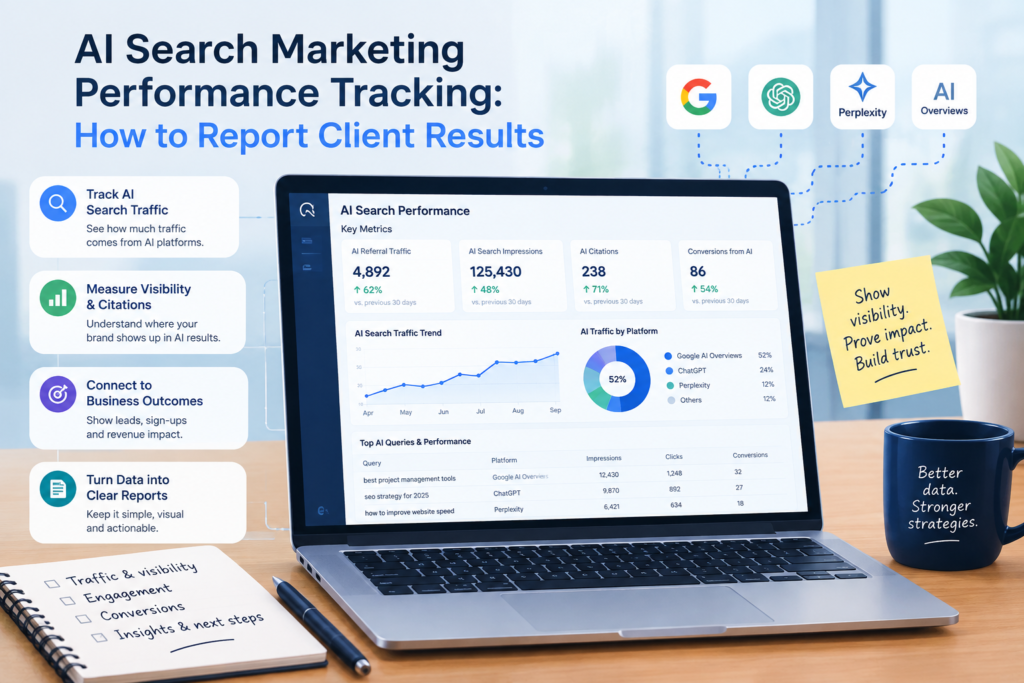
A client recently told me, “Our Google rankings look great.” Then I checked how often AI answers mentioned them. Their competitors showed up far more often.
That gap is why AI search marketing performance tracking now matters. Rankings still count, but they no longer tell the whole story. Clients want to know one thing: “Are we showing up in AI search?”
This guide walks through how I answer that question. You’ll learn how I build a query set, which metrics I report, which ones I skip, and the mistakes I see most often.
SEO PACKAGE:
SEO Title (52 characters)
AI Search Marketing Performance Tracking for Clients
Meta Description (152 characters)
Learn AI search marketing performance tracking: which queries to monitor, which metrics to report, and how to show clients genuine AI visibility gains.
URL Slug
/ai-search-marketing-performance-tracking
Primary Keyword:
AI search marketing performance tracking
Secondary Keywords:
LLM brand mentions
how to track AI search performance
AI search visibility
generative engine optimization (GEO)
tracking AI Overviews
AI search reporting for clients
What AI Search Marketing Performance Tracking Actually Means
Traditional SEO asks, “Where do we rank?” AI search visibility asks a different question: “Does the AI mention us, cite us, or link to us?”
Those are three separate outcomes:
- Mentioned: the brand name appears in the answer.
- Cited: your content is used as a source.
- Linked: the answer sends users to your site.
A brand can be mentioned without being linked. It can also be cited without being named in the answer. Tracking all three gives you a much clearer picture.
I check the platforms clients’ customers actually use. That usually means Google AI Mode, AI Overviews, and ChatGPT.
Step 1: Build a Focused Query Set
Most tracking problems start here. People either track too little or far too much.
I build the set around business value and search intent, not search volume. For a new client, I include:
- Product or service searches
- Comparison queries
- “Best” and “how to” questions
- Problem-based searches
- A mix of branded and non-branded queries
- Queries where competitors already appear in AI results
Then I keep the list small enough to monitor consistently. Hundreds of random prompts create noise. A focused set creates a baseline you can trust.
Step 2: Record What the AI Says
For each query, I log the same details every time:
- Was the brand mentioned, cited, or linked?
- Which competitors appeared?
- Which sources did the AI use?
- Did the answer describe the brand accurately?
The source list is often the most useful part. It shows which pages AI systems trust in your market. It also shows where your content is missing.
Google explains that AI Overviews and AI Mode may run several related searches behind the scenes to build one answer. The responses and links can differ between the two features, so I track each one separately. bugsmash
Step 3: Repeat on a Schedule
One check tells you very little. AI answers change often, so a single result is a snapshot, not a trend.
I run the same query set at regular intervals. Then I look for direction: is visibility improving, declining, or holding steady?
Which Metrics to Report to Clients
I report metrics that show visibility and business impact. Here’s what makes the cut, and what doesn’t:
| Metric | What it tells the client | Report it? |
| AI visibility rate | How often the brand appears across tracked queries | Yes |
| Mention and citation rate | How often the brand is named or used as a source | Yes |
| Share of tracked queries | How many key queries include the brand | Yes |
| Competitor visibility | Who appears alongside or instead of the brand | Yes |
| Referral traffic and conversions | Real visits and leads from AI search | Yes, when reliably connected |
| A single AI “position” | A rank that shifts constantly | No, supporting evidence only |
| Raw prompt counts | Activity, not results | No |
| Isolated screenshots | One-off proof | No, supporting evidence only |
Be honest about attribution. Connecting AI search to traffic and leads isn’t always clean. I only show those numbers when I can link them reliably, and I tell clients when I can’t.
Google also notes that sites appearing in AI features are included in overall search traffic in Search Console, within the Performance report. That means you can’t always split AI traffic from regular search traffic there. Some third-party sources report newer AI-specific views in Search Console, so check your own account for what’s currently available. google
The Biggest Mistakes in AI Search Tracking
Treating AI answers like a ranking list
This is the most common mistake I see. People ask, “Are we #1 in the answer?” That question misses the point.
AI answers don’t work like a list of ten blue links. A brand that appears consistently across many queries is usually in better shape than one that appears first once.
Tracking too many random prompts
More prompts don’t mean better data. A bloated list hides patterns. Keep it tied to business-critical queries and monitor them over time.
Reporting screenshots as proof
A screenshot shows one moment. It’s fine as supporting evidence. It shouldn’t be your headline KPI.
A Real Example: Strong Rankings, Weak AI Visibility
One B2B client had strong traditional Google rankings. On paper, everything looked healthy.
When we tracked their most important AI queries, competitors were being mentioned and cited much more often. The conversation changed from “our rankings are fine” to “why aren’t AI systems using our content?”
We looked at the pages AI systems were citing. Then we updated the client’s pages with:
- Clearer first-hand information
- Stronger supporting evidence
- More direct answers to real customer questions
After the updates, we kept tracking the same query set. That let us see whether the brand appeared more consistently over time.
Results vary by industry and competition. Content changes don’t guarantee citations. But without tracking, we would never have spotted the problem.
Quick Checklist for Your Next Client
- Pick 15 to 30 business-critical queries (adjust for client size).
- Mix branded and non-branded searches.
- Check Google AI Mode, AI Overviews, and ChatGPT.
- Log mentions, citations, links, competitors, and sources.
- Repeat on a fixed schedule.
- Report trends, not single results.
- Update weak pages, then keep tracking.
FAQs
How do I track client performance in AI search?
Build a focused set of business-critical queries. Check them regularly across AI platforms. Record whether the brand is mentioned, cited, or linked, and compare the results against competitors over time.
What is AI search visibility?
AI search visibility is how often a brand appears in AI-generated answers. It covers mentions, citations, and links across the queries that matter to the business.
Do I need special schema to appear in AI Overviews?
No. Google says there’s no special schema.org structured data required for AI features, and regular SEO best practices still apply. google
Should I report an AI search “position”?
I don’t. Answers change often, so a single position isn’t stable. Visibility rate and citation rate give a more honest picture.
Conclusion
There are basically 3 habits for good AI search marketing performance tracking. Target questions pertinent to the business. Avoid chasing ‘#1’ – mention, cite and link. Follow the same set over time to enable the data to have meaning.
Start small. Choose your questions for the week, conduct your first set and present them to your client and how they’re doing. Next, take what you discovered to help enhance the other pages that AI systems haven’t gotten to yet.
Sources to link:
- Google Search Central: AI features and your website (do-follow)
- Google: Search Console Performance report (do-follow)
- SerpApi: The state of the SERP in the age of AI (optional, third-party context)
Looking for a trusted digital marketing expert in Kochi I help local businesses, startups, and growing brands get found online, attract the right customers, and turn clicks into real sales. With hands-on experience in SEO, Google Ads, social media marketing, content strategy, and lead generation, I build tailored campaigns that fit your goals and budget. Whether you run a restaurant in Fort Kochi, a clinic in Edappally, or an online store serving all of Kerala, my data-driven approach ensures measurable growth, higher rankings, and a stronger brand presence. If you want a digital marketing partner who understands the Kochi market and delivers results, let’s connect and grow your business together.