Google AI Mode monitoring is now rolling out to everyone, not only paying subscribers. Robby Stein, Google’s VP of Product for Search, said Ultra and Pro subscribers had used the capability before the wider rollout. Most coverage focuses on shoppers waiting for price drops. That makes sense. But if you manage search for a brand, a bigger question sits underneath: what happens when AI answers change and nobody is watching? digitalinformationworld
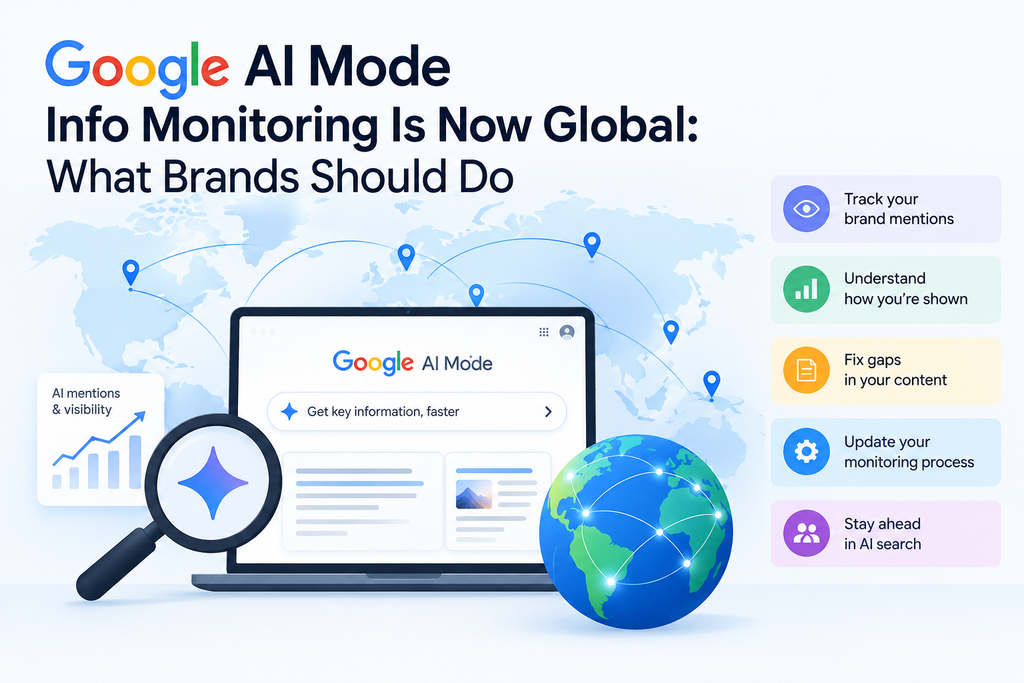
I’ve been tracking exactly that. In this post, I’ll explain what Google AI Mode monitoring does, share a real example of a brand losing a citation, and give you a weekly process you can start this week.
What Is Google AI Mode Monitoring?
Think of it as a standing search. You tell AI Mode what to watch, and Search keeps checking for updates, and Search will also suggest monitoring tasks while you search. searchenginejournal
Google’s examples were mostly local and shopping topics: new restaurants or pop-ups nearby, holiday activities for kids, and back-in-stock or price-drop updates. Reports say Search checks websites, forums, social posts, real-time data, and Google’s Shopping Graph of more than 60 billion products. digitalinformationworld
The timeline is short:
- May 2026: At I/O, Google said information agents would launch first for AI Pro and Ultra subscribers. searchenginejournal
- 12 June 2026: Information agents launched for AI Ultra subscribers only. keywordseverywhere
- 28 September 2026: Stein announced that info monitoring is rolling out to everyone globally in the Google app. relevantaudience
Google now says “info monitoring” instead of “information agents.” Expect both terms in search results for a while.
What We Don’t Know Yet
Some key details are missing, so treat early claims with care.
- Local businesses and retailers can’t yet tell how often monitoring will surface their sites or send them visits. searchenginejournal
- Google called the rollout global but published no language list. keywordseverywhere
- Usage limits between free and paid plans remain unspecified. almcorp
So I wouldn’t promise a client a traffic jump from Google AI Mode monitoring. What you can control is how closely you watch the answers that mention your brand.
Why Brands Should Track AI Answers
Every monitored topic is a standing question. Each time AI Mode answers it, the system chooses which sources to cite and which brands to name. If a competitor wins that answer, they win that moment.
Google built this feature for people tracking topics. I use the same idea for brands: I check AI Mode answers on a fixed schedule and record what changes. That routine has shown me things a one-off check never would.
A Real Example: A Brand Loses a Citation
This is one case from my own work, so your results may differ.
What I noticed
A brand I was tracking stopped being cited for an important commercial query. A competitor started appearing in its place.
What I found
I compared the two pages side by side. The competitor’s page had clearer product comparisons and more specific supporting details. Our page was vaguer.
What I changed
I updated the brand’s page with original comparisons and clearer product details. I didn’t copy the competitor. I made our page more useful.
What happened
About 2 to 3 weeks later, the brand appeared in the AI results again. I kept checking those queries during that period to confirm the change held.
The lesson: AI answers favor pages that are specific and easy to use. Vague pages lose ground quietly.
How to Set Up Google AI Mode Monitoring for Your Brand
You don’t need expensive tools to start. Here is my process:
- Pick 20 to 30 high-value queries. Cover different intents (see the table below).
- Run each query in Google AI Mode. Use the same wording every time.
- Record three things. Note whether your brand appears, which pages get cited, and which competitors show up.
- Repeat weekly. Use the same queries so you can compare changes over time.
- Investigate big shifts. When a citation disappears or a competitor appears, compare the pages and look for gaps.
| Query type | Example | What to watch |
| Branded | “[brand] reviews” | Is the answer accurate and favorable? |
| Commercial | “best [product] for [use case]” | Are you cited, or is a competitor? |
| Comparison | “[brand] vs [competitor]” | Which page is the source? |
| Informational | “how to choose [product]” | Do your guides get cited? |
A simple spreadsheet works. Add a column for the date, one for each competitor, and one for notes.
Three Mistakes I See Often
Checking once and calling it done. Treating Google AI Mode monitoring as a one-time task gives you a snapshot, not a trend. AI answers change.
Only asking “Are we mentioned?” Appearing is only part of the picture. You also need to know which sources get cited and how the answer changes over time.
Ignoring competitors. When a rival gains a citation, their page usually has something yours lacks. That’s free research.
If you want to connect this data to revenue, read my guide on AI search metrics for tracking client pipelines.
What to Do This Week
Keep it simple:
- Write down 20 to 30 customer queries that matter most.
- Run each one through Google AI Mode.
- Record whether your brand appears, which pages are cited, and which competitors are mentioned.
- Save the results as your baseline.
- Re-check next week and look for changes.
Without that baseline, you can’t tell whether a change is good or bad.
FAQs
What is Google AI Mode monitoring?
It’s a feature that keeps checking for updates on a topic you ask AI Mode to watch. Search can also suggest monitoring tasks as you search.
Is Google AI Mode monitoring free?
It was previously limited to Google AI Pro and Ultra subscribers, but it’s now available to everyone. Usage limits haven’t been spelled out. searchenginewatch
How often should I check AI results for my brand?
I check weekly. That’s frequent enough to catch changes and light enough to keep up.
How long does it take to regain a lost citation?
In my example, about 2 to 3 weeks after updating the page. That’s one case, so treat it as a rough guide.
Conclusion: Start With a Baseline
Google AI Mode monitoring turns Search into an ongoing assistant, and it’s now open to everyone. For brands, the takeaway is simple: don’t treat AI visibility as permanent. Track your key queries, watch the cited sources, and learn from competitors. Build your 20 to 30 query baseline this week and let the weekly changes show you where your content needs work.
SEO Package
| Element | Recommendation |
| SEO title (52 chars) | Google AI Mode Monitoring: What Brands Should Do Now |
| Meta description (154 chars) | Google AI Mode monitoring is now global. Learn how to track brand citations, spot competitor shifts, and build a weekly baseline you can act on right now. |
| URL slug | /google-ai-mode-monitoring |
| Primary keyword | Google AI Mode monitoring |
| Secondary keywords | AI Mode info monitoring, Google information agents, AI citations, AI Mode SEO impact, AI Mode for local businesses, AI visibility tracking |
| Search intent | Informational with a practical, how-to angle |
| Schema | Article + FAQPage (add HowTo for the setup steps if you want) |
Links
- Internal: /ai-search-metrics-client-pipelines (already in the article). Add one or two more to your own GA4 or AI visibility posts.
- External (do-follow): Search Engine Journal’s report and Search Engine Roundtable’s recap.
Looking for a best trusted digital marketing expert in Kochi I help local businesses, startups, and growing brands get found online, attract the right customers, and turn clicks into real sales. With hands-on experience in SEO, Google Ads, social media marketing, content strategy, and lead generation, I build tailored campaigns that fit your goals and budget. Whether you run a restaurant in Fort Kochi, a clinic in Edappally, or an online store serving all of Kerala, my data-driven approach ensures measurable growth, higher rankings, and a stronger brand presence. If you want a digital marketing partner who understands the Kochi market and delivers results, let’s connect and grow your business together.