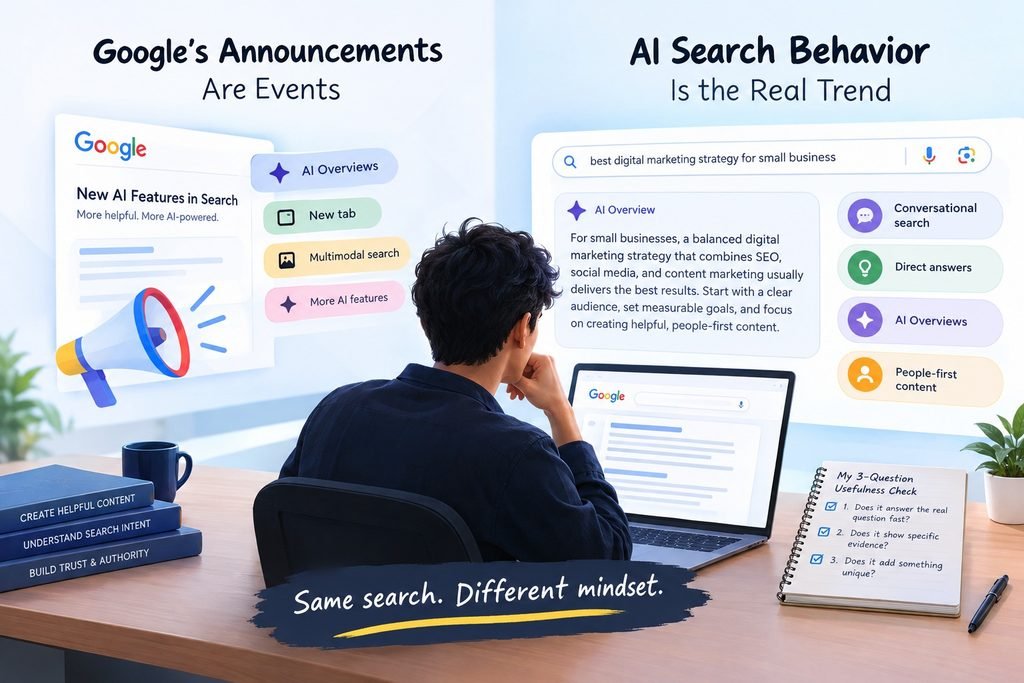
Every few months, Google announces another AI feature, and the industry scrambles. New labels, new tabs, new hot takes. But the announcements aren’t the story. AI search behavior is.
The way people search has changed, and it will keep changing no matter what Google ships next. Here’s what I’ve seen, what I changed in my own work, and a one-hour plan you can run this week.
Why Google’s AI Announcements Are Events
An announcement is a moment. A launch, a demo, a rollout. It gets attention for a week, then the next one arrives.
A trend is slower and harder to argue with. People got used to asking questions in full sentences, and they now expect a useful answer back. That expectation doesn’t reset when a feature name changes.
If you build your content plan around each launch, you’ll always be a step behind. If you build it around the searcher, you don’t have to rewrite the plan every quarter.
Google’s own documentation points the same way. Its guidance on AI features in Search says the same SEO fundamentals apply, with no special optimization required. Its guidance on creating helpful, people-first content asks for pages written for readers first.
SEO Package
SEO title (59 characters): AI Search Behavior: The Trend Behind Google’s Announcements
Meta description (154 characters): Google’s AI announcements come and go. AI search behavior is the real trend. Learn how searchers changed and how to update your top three pages this week.
URL slug: /ai-search-behavior-google-announcements
Primary keyword: AI search behavior
Secondary keywords: Google AI announcements, conversational search, search intent, AI Overviews, people-first content
Search intent type: Informational
Schema: Article schema for the post, plus FAQPage schema for the FAQs
How AI Search Behavior Has Changed
Two shifts in AI search behavior show up again and again.
Searchers ask longer, more specific questions
People used to type short keywords. Now they describe a situation. They add their constraints, their worries, and what they actually need to decide.
That’s a shift in search intent, not just query length. People now state the problem behind the search.
Conversational search has taken over. Your page has to sound like a good answer to that conversation, not a match for a keyword.
They expect an answer, not a list of links
Searchers want a direct answer and a practical recommendation. The links are the backup plan. AI Overviews trained people to expect this.
If your page makes them dig, they’ll take the summary and move on. Here’s how the two searchers compare:
| Keyword-era searcher | Today’s searcher | |
| Query | Short keyword | Full, problem-focused question |
| Expectation | A list of links to compare | A direct answer and a recommendation |
| Patience for fluff | Scrolls past it | Leaves the page |
| What wins | Coverage of the keyword | Clarity, evidence, and a next step |
What I Changed on a Competitive Local Service Page
I worked on a service page targeting a competitive local search. The usual approach is to write a comprehensive page around the main keyword. Cover everything, hit the headings, repeat the phrase in the right places.
I dropped that. I built the page around the questions and decisions a visitor actually has to make. What does this cost? How do I know I need it? What happens first? How do I choose a provider?
Each section answered one of those questions directly, then pointed to a next step. That change came straight from watching AI search behavior, not from chasing a feature announcement.
I’ll be straight about results. I don’t have a clean before-and-after number I can stand behind, so I won’t invent one. What I can share is the reasoning: a page built around a visitor’s decisions gives people and search systems the same thing, a clear answer. Your results will depend on your market, your competition, and how strong the page was to begin with.
The Biggest Mistake: Writing for “AI-Friendly” Wording
The most common mistake in adapting to AI search behavior is writing for the machine instead of the reader. People stuff in keywords. They paste in generic Q&A blocks and hope an AI summary picks them up.
That’s chasing the announcement again. What works is less exciting:
- Clear answers stated early
- Concrete facts and specifics
- Enough context for the answer to make sense
- Credible evidence behind your claims
A quick test: if your FAQ could sit on any competitor’s site without changing a word, it isn’t helping you.
My Three-Question Usefulness Check
When I review a page, I ask three things, in this order:
- Does it answer the real question fast? Can I get the key takeaway without digging through fluff?
- Does it show specific evidence? Look for examples, data, firsthand details, or clear next steps rather than generic statements.
- Does it add something competing pages don’t? If it doesn’t, why would a searcher choose it?
If a page fails the first question, I stop there and fix it before touching anything else.
What to Do With One Hour This Week
You don’t need a full content overhaul. Try this instead:
- Pick your top three pages that already get search traffic. Search Console will show you.
- Write down the main search intent each page should answer, in one sentence.
- Rewrite the opening so it answers that question directly.
- Add concrete examples, original insight, and a clear next step to each page.
- Cut anything that doesn’t help the reader reach the answer faster.
Start with pages that already have traffic. They have the most to gain and the least risk.
FAQs
What is AI search behavior?
AI search behavior describes how people search now that AI answers are part of the results. They ask longer, more specific questions and expect a direct answer with a recommendation.
Do I need different SEO for Google’s AI features?
Google’s documentation says no special optimizations are needed beyond solid SEO fundamentals. Helpful, clear, well-supported content is still the foundation.
Does AI search behavior mean keywords no longer matter?
They still matter as a starting point for understanding search intent. But a page built only around a keyword usually loses to one built around the visitor’s actual question.
How long until I see results?
It varies. It depends on your competition, your site, and how much the page improves. Anyone who promises a timeline is guessing.
Looking for a trusted digital marketing expert in Kochi I help local businesses, startups, and growing brands get found online, attract the right customers, and turn clicks into real sales. With hands-on experience in SEO, Google Ads, social media marketing, content strategy, and lead generation, I build tailored campaigns that fit your goals and budget. Whether you run a restaurant in Fort Kochi, a clinic in Edappally, or an online store serving all of Kerala, my data-driven approach ensures measurable growth, higher rankings, and a stronger brand presence. If you want a digital marketing partner who understands the Kochi market and delivers results, let’s connect and grow your business together.