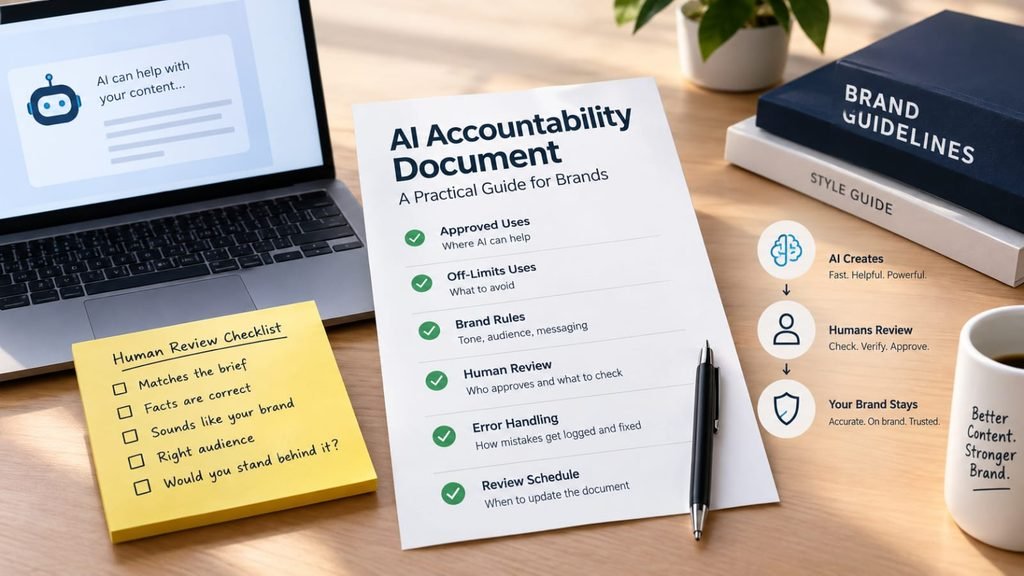
Your brand probably has a style guide. It probably doesn’t have an AI accountability document, and that’s where off-brand content gets through.
The document is a short written policy for how your team uses AI. It says who reviews what the tool produces and what happens when it gets something wrong. It isn’t a contract or a technical manual. It answers one question: when AI misrepresents our brand, who’s responsible?
Below, I’ll cover how to write one, what a school district got right, and a checklist you can use this week.
What an AI accountability document actually is
Picture a brand AI policy that fits on one or two pages. It has three parts:
- Rules: what AI can and can’t be used for.
- Owners: the named people who approve AI-assisted work.
- Checks: what those people verify before anything goes live.
It doesn’t replace your AI brand guidelines or your regular style guide. It sits on top of them and makes sure someone actually enforces them when AI is involved.
SEO Title (50 characters): AI Accountability Document: Essential Checklist for Brands
Meta Description (154 characters): An AI accountability document keeps AI-written content on brand. Learn what to include, how human review works, and a simple checklist to start this week.
URL Slug: /ai-accountability-document
Primary Keyword: AI accountability document
Secondary Keywords: AI accountability framework, brand AI policy, human review of AI content, AI governance for brands, AI brand guidelines
Search Intent: Informational (how-to)
What a school district can teach brands
The idea isn’t limited to marketing teams. One school district has already put it into practice. Greg Jarboe covered ABRSD’s AI accountability document in Search Engine Journal, and the district finished it months before Oren Cass argued in the New York Times that Big Tech’s build-first habits don’t hold up with AI. According to Jarboe, the guidebook expects staff to be upfront about their own AI use. Then the district asked the people most affected: its high schoolers. In a March 2026 survey, 79% said they could tell when a GenAI tool would let them skip learning they needed to do. And 72% said their teachers were clear about when AI use was allowed.
The best model I’ve come across wasn’t from a tech company. What stands out to me isn’t the school setting. It’s the sequence: write the rule down, name who’s responsible, then ask whether it worked. Most brands stop after the first step, if they get that far.
A real example: when AI misreads your brand
I’ve seen this go wrong up close. An AI tool described a brand as “premium and traditional.” In reality, the brand was modern, accessible, and aimed at a younger audience. The copy read well, which made the mismatch easy to miss. It was polished, but it wasn’t the brand.
We found it during a routine review, when someone compared the output with the original requirements. Fixing it meant extra time and rewrites before publishing. Nothing went live, but only because someone looked.
Afterward, we added a checklist. Before anyone signed off, the AI output had to match the requirements on three things:
- Key details
- Tone
- Audience
It’s a small change, and the same mistake hasn’t come back.
What to put in your AI accountability document
Keep it short enough that people will read it. Here’s a simple AI accountability framework you can copy:
| Section | What to write | Example |
| Purpose | Why the document exists | “Keep AI-assisted content accurate and on brand” |
| Approved uses | Where AI can help | Drafting, summarizing, brainstorming |
| Off-limits uses | Where it shouldn’t be used | Final legal claims, pricing, customer promises |
| Brand rules | Tone, audience, messaging | A link to your brand guidelines |
| Human review | Who approves and what they check | A named editor plus the checklist below |
| Error handling | How mistakes get logged and fixed | A shared log with the date and the fix |
| Review schedule | When the document gets updated | Every quarter |
If you only include one thing, make it the human review requirement. It gives you one clear point of accountability, and it catches factual errors, tone mismatches, and off-brand content before publication, which is when they do the most damage.
The human review checklist
Human review of AI content works best when the reviewer knows exactly what to look for. Start here:
- Does the content match the original brief?
- Are the names, prices, dates, and product details right?
- Does it sound like your brand?
- Is it written for the right audience?
- Would you stand behind every claim if a customer challenged it?
The reviewer signs off only when every box is ticked. That sign-off is where the accountability lives.
Common mistakes to avoid
The mistake I see most is letting AI produce content with no brand guidelines and no human review. Fixing it takes two steps:
- Give the AI clear rules for tone, audience, and messaging.
- Have a named person check the output before it goes live.
A few others to watch for:
- Never updating the document. AI tools change quickly, so review it every quarter.
- Letting it grow too long. If nobody reads it, nobody follows it.
- Assigning a team instead of a person. “Marketing” can’t be held accountable. One person can.
Limits to keep in mind
An accountability document cuts down on risk, but it won’t eliminate it. Reviewers get tired. Checklists miss the strange, subtle stuff. And not everything deserves the same level of scrutiny: a social caption can go through a quick read, while a pricing page or a regulated claim needs a much harder look. If a piece has legal or compliance implications, don’t rely on the marketing team alone. Pull in whoever owns that area.
What’s an AI accountability document?
Think of it as a one-page rulebook for how your team uses AI. It covers what’s allowed, who signs off on AI-assisted work, and what happens when something slips through wrong.
How long should it be?
Aim for a page, two at the outside. Once it gets longer, people skim it or skip it entirely, and a policy nobody reads can’t hold anyone to anything.
Who should own it?
One named person, not a committee. Usually that’s whoever leads marketing, brand, or content. They can hand day-to-day review to others, but the buck stops with one name.
Isn’t this just our brand guidelines?
Not quite. Brand guidelines tell you what the brand should look and sound like. This document covers the step after that: how you check AI-generated work against those guidelines before it goes out the door.
Looking for a trusted digital marketing expert in Kochi I help local businesses, startups, and growing brands get found online, attract the right customers, and turn clicks into real sales. With hands-on experience in SEO, Google Ads, social media marketing, content strategy, and lead generation, I build tailored campaigns that fit your goals and budget. Whether you run a restaurant in Fort Kochi, a clinic in Edappally, or an online store serving all of Kerala, my data-driven approach ensures measurable growth, higher rankings, and a stronger brand presence. If you want a digital marketing partner who understands the Kochi market and delivers results, let’s connect and grow your business together.