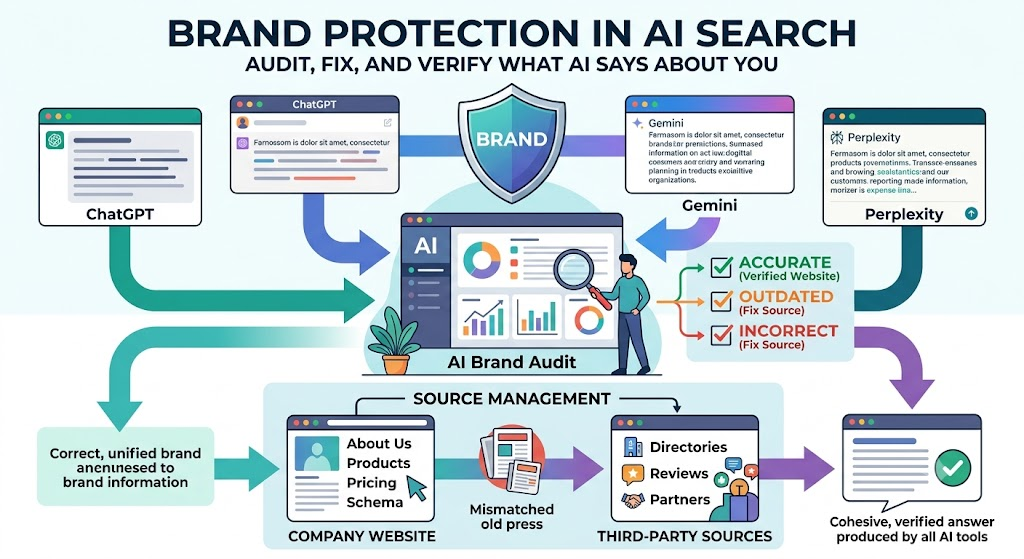
Ask ChatGPT, Gemini, and Perplexity the same question about your company. Then read the answers side by side. Odds are, they won’t match.
That mismatch is why brand protection in AI search has become a real job. Your website used to be the main place people learned who you are. Now AI tools blend your site, reviews, directories, and old press into one summary, and they repeat it to thousands of buyers.
The good news is that you can check it. This guide walks you through a simple AI brand audit, the fixes that work, and a plan for your first week.
SEO Package
| Element | Details |
|---|---|
| SEO title (59 characters) | Brand Protection in AI Search: Audit What AI Says About You |
| Meta description (145 characters) | Brand protection in AI search starts with a simple test: ask ChatGPT and Perplexity about your company, then fix what they get wrong. Here’s how. |
| URL slug | /brand-protection-in-ai-search |
| Primary keyword | brand protection in AI search |
| Secondary keywords | AI brand audit, brand reputation in AI search, AI search visibility, brand identity in AI search, AI hallucinations about brands, AI search brand monitoring |
| Search intent | Informational (how-to) |
| Schema | Article + FAQPage |
Why Brand Protection in AI Search Matters
Search used to be a list of links. Now it’s often one summarized answer. ChatGPT, Perplexity, and Google’s AI features pull from many sources and merge them into a single description of your brand.
You can’t edit that summary directly. You can shape the sources it learns from. That’s the core of brand protection in AI search: manage the information trail, because the AI repeats what it finds.
The risks are easy to spot:
- Outdated information: old products, old positioning, old leadership
- Incorrect claims: wrong pricing, features, or locations
- Misattributed services: things you don’t offer, credited to you
- Missing information: the AI skips you for queries you should own
How to Run an AI Brand Audit
An AI brand audit doesn’t need special software. It needs consistency.
- Test a fixed set of prompts. Use the same real questions every time so you can compare results over time.
- Record what each AI says. Save answers in a spreadsheet with the date and tool name.
- Verify every claim. Check each statement against your current website, pricing, and official sources.
- Compare across models. Patterns beat single answers. If three tools repeat one error, a shared source is probably feeding it.
- Compare against competitors. Ask the same questions about them, and note where they’re described more clearly than you are.
Prompts to Include
Start with questions a real buyer would ask:
| Prompt type | Example |
| Positioning | “What is [Brand] best known for, and who is it best suited for?” |
| Product accuracy | “What products or services does [Brand] offer?” |
| Pricing | “How much does [Brand] cost?” |
| Comparison | “How does [Brand] compare to [Competitor]?” |
| Recommendation | “What are the best [category] providers for [audience]?” |
I’d run the positioning prompt first. It tests two things at once: whether the AI knows what you’re known for, and whether it knows who you serve.
A Real Example: Three Tools, Three Different Answers
In one 2026 audit, I tested Pennylane, a French finance-software brand. Across 10 queries, Gemini mentioned it every time. Perplexity mentioned it in 6. ChatGPT mentioned it in only 3, and often pointed users to QuickBooks or FreshBooks instead.
The brand hadn’t changed. The gap was visibility and positioning. Each tool simply had a different picture of who Pennylane serves.
That’s a small sample, and AI answers shift over time, so treat it as a snapshot, not a verdict.
The Most Common Mistake: Assuming AI Understands Your Positioning
Most brands assume the AI already knows who they are today. It doesn’t.
AI tools learn from what’s published across the web. If your site says one thing, an old directory says another, and a three-year-old article says a third, the AI can’t tell which is current. It repeats the messy version.
The problem is rarely the AI. It’s inconsistent, outdated, or poorly structured information across your own site and third-party sources.
How to Fix Wrong AI Answers
When the audit turns up errors, don’t argue with the chatbot. Telling an AI “that’s wrong” may change one conversation. It doesn’t change the sources it draws from.
| Approach | Effect |
| Correcting the AI in chat | Temporary, affects one conversation |
| Fixing your website and third-party listings | Lasting, changes what future answers draw from |
Here’s the order I’d follow:
- Write down the correct facts in one internal document.
- Fix your own site first. Update your About, product, and pricing pages so they match.
- Use the same words everywhere. Describe what you do, who you serve, and what sets you apart in identical language.
- Correct third-party sources. Update directories, review profiles, and partner pages. Ask publishers to fix outdated articles.
- Add structured data. Schema markup helps machines read your facts. Start with Google’s Organization structured data guide and the Schema.org Organization type.
In my audits, consistency did more than anything else. When the same positioning and facts appeared on the website and on trusted outside sources, the answers got steadier.
Your First-Week Action Plan
You don’t need a big budget. Try this:
- Monday: Ask ChatGPT, Perplexity, and Google to describe your brand. Screenshot every answer.
- Tuesday: Read each one with a red pen. Flag what’s wrong, outdated, or missing.
- Wednesday and Thursday: Fix those facts on your own site first. It’s the one source you fully control.
- Friday: Open your key pages side by side. Your description, audience, products, and differentiators should match everywhere.
You’ll finish with a baseline and a short list of what to fix next.
What to Expect (and What You Can’t Control)
Results won’t show up overnight. Each AI tool updates on its own schedule, and some answers still come from older training data. Ask the same question twice, on different days, and you may get two different answers.
So treat your AI brand audit as a habit. Run it monthly or quarterly, and again after a rebrand, price change, or launch. Some AI hallucinations about brands vanish once their sources are corrected. Others keep coming back, and the only way to catch them is to keep looking.
FAQs
What is brand protection in AI search?
It means checking how AI tools describe your company and fixing what they get wrong, so people who ask about you get accurate answers.
How often should I audit my brand in AI search?
Quarterly is enough for most brands. Add an extra check after big changes, like a new name, product, or pricing.
Can I ask ChatGPT to correct wrong information about my brand?
You can correct it inside your own chat, but that almost never carries over to other people’s answers. The dependable fix is updating your website and the third-party pages AI tools pull from.
Do I need special tools for an AI brand audit?
Not to start. A spreadsheet and a fixed list of prompts will do. If you track many brands or products, paid AI search brand monitoring tools can save time.
Conclusion: Start Your Brand Protection in AI Search This Week
You can’t control what AI says about you. You can control what it reads. Run your questions through the tools, find the biggest mismatch, and fix it at the source.
Brand protection in AI search comes down to one habit: check, correct, and repeat. Start with Monday’s prompts, and you’ll have your first baseline by Friday.
Looking for a trusted digital marketing expert in Kochi I help local businesses, startups, and growing brands get found online, attract the right customers, and turn clicks into real sales. With hands-on experience in SEO, Google Ads, social media marketing, content strategy, and lead generation, I build tailored campaigns that fit your goals and budget. Whether you run a restaurant in Fort Kochi, a clinic in Edappally, or an online store serving all of Kerala, my data-driven approach ensures measurable growth, higher rankings, and a stronger brand presence. If you want a digital marketing partner who understands the Kochi market and delivers results, let’s connect and grow your business together.