By [Milan Mathew]
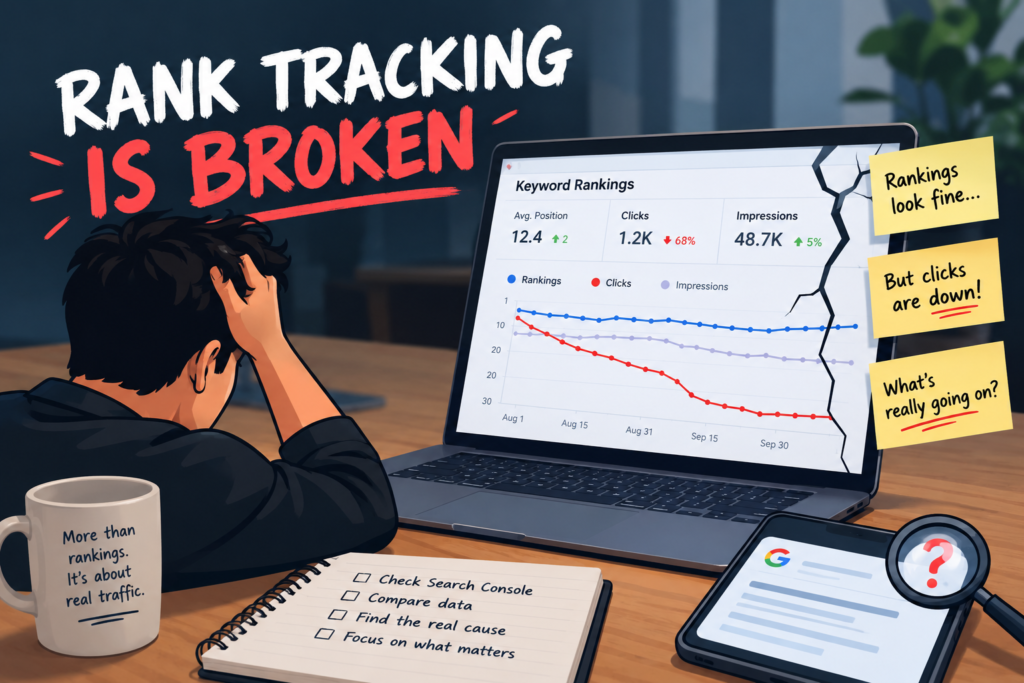
In September, I noticed something strange in my reports. Some of my keywords held their positions, yet clicks and organic traffic kept falling. If you track SEO the old way, that gap makes no sense. And that is exactly why rank tracking is broken as a stand-alone measure of success.
This post covers what changed, what I checked first, and what I track now instead of positions alone.
Why Rank Tracking Is Broken
For years, a keyword ranking report felt like a scoreboard. You moved from position 8 to position 4, and everyone cheered.
But a position is just a position. It does not tell you whether anyone clicked, whether they trusted your brand, or whether they became a customer. Three things have made that gap impossible to ignore:
- AI-generated answers now sit above or beside traditional results, so a top ranking can earn fewer clicks than it used to.
- Search behavior is shifting. People ask longer questions and often get the answer without visiting a site.
- The data itself changed. In mid-September 2025, Google stopped honoring the &num=100 parameter. Many rank trackers used it to pull 100 results in a single request, so those tools lost their easy view of positions 11 to 100.
Google did not announce the change in a blog post. When asked, it reportedly called the parameter not an officially supported feature.
What the num=100 change did to Search Console
Many site owners also saw a sharp drop in impressions in Google Search Console, mostly on desktop. A likely reason is that bots from rank trackers had been loading those 100-result pages and getting counted as impressions. When the parameter stopped working, that automated noise disappeared.
Here is the important part. Lower impressions after that date do not automatically mean your SEO got worse. But it does mean that any report comparing “before” and “after” September needs a clear note. Otherwise, you will chase a problem that is really a measurement change.
What I Saw in My Own Data
My situation was a little different from the impressions story. My rankings looked steady, but my clicks dropped. Impressions stayed relatively stable. So people were still seeing my site in search results. They just were not clicking as often.
Here is the honest caveat: my site is small, and the numbers are tiny. In the data I checked, my homepage had 4 impressions and my SEO Skills Gap article had 1. That is far too little to draw firm conclusions. Treat my findings as early signals, not proof. Your results may look different, especially if you run a larger site.
Still, the process I followed works at any size.
How I Investigated Before Changing Anything
My first rule was simple: find the cause before touching the site. Panic edits often make things worse. Here is the order I worked in.
- Open Google Search Console. I compared clicks, impressions, and average position side by side.
- Compare with previous months. One weak week proves nothing. A trend does.
- Find the pages losing clicks. For me, that was the homepage and my blog posts on SEO and AI search.
- Check search intent. I asked whether the query still matched what the page offered.
- Review titles and meta descriptions. A page can rank well and still fail to earn the click.
- Look for AI-answer effects. I checked whether the topics I target now trigger AI-generated summaries.
Only after those steps did I start improving content, titles, and descriptions.
Common mistakes I would avoid
- Reporting average position as if it were a result.
- Comparing August and October impressions without noting the September data change.
- Rewriting a whole site because one metric moved.
- Ignoring click-through rate.
What I Track Instead of Rankings Alone
Rankings still have a place. They are a useful diagnostic. They are just a poor headline number. Here is what I track now, and where I find it.
| Metric | What it tells you | Where to find it |
| Organic clicks | Whether people actually visit | Google Search Console |
| Impressions | How often you appear | Google Search Console |
| Brand searches | Whether people know your name | Google Search Console |
| Engagement | Whether visitors find value | Google Analytics 4 |
| Conversions | Whether visits lead to action | Google Analytics 4 |
| Leads and enquiries | Whether traffic becomes business | CRM or contact forms |
| AI referral traffic | Whether tools like ChatGPT send visitors | Google Analytics 4 referral reports |
Brand searches deserve special attention. When more people search for your business by name, your brand visibility is growing, even if a generic keyword position stays flat.
AI referral traffic is a newer signal. AI tools can shape how people discover a brand, so I watch for visits coming from platforms like ChatGPT. The volume is often small today. But it shows where discovery is heading.
A simple framework you can copy
I think about measurement in three layers:
- Visibility: impressions, brand searches, AI mentions.
- Engagement: clicks, time on page, scroll depth.
- Business results: conversions, qualified leads, revenue.
If you only report layer one, you are showing the least meaningful data. Push your reporting toward layer three.
How to Shift Your SEO Reporting to Revenue
You do not need a new tool stack. Start with what you already have.
- Set up conversions in GA4. Track form submissions, calls, and purchases.
- Add a September annotation. Mark mid-September 2025 in your Search Console and dashboard notes so future readers understand the data break.
- Segment brand and non-brand queries. This shows whether growth comes from awareness or from new discovery.
- Tie traffic to leads. Ask new enquiries how they found you.
- Report rankings last. Put them at the bottom of the deck, as supporting context.
One limitation to keep in mind: attribution is never perfect. A customer may see your brand in an AI answer, search for you a week later, and convert through direct traffic. Your reports will not capture every step. That is fine. Aim for a reasonable picture, not a perfect one.
Frequently Asked Questions
So, is rank tracking really a thing of the past?
No. It can still be of any value when detecting trends and pinpointing issues. Proving the success of SEO is not enough.
What happened to my impressions in search console in September 2025?
A significant number of sites experienced declines as Google no longer supported the &num=100 parameter which limited a large number of automated and tool-generated impressions. If you’re thinking that your clicks and conversions have fallen, see if they’ve shifted drastically as well.
How should I perceive keyword rankings if not?
Measure clicks, impressions, brand search, engagement, conversions and qualified leads. Combine Google Search Console and Google Analytics 4.
Is it possible to monitor website traffic from ChatGPT?
Often, yes. Look for referral traffic from AI platforms in your GA4 reports. Some volumes are very small and not all AI visits are properly labelled.
In conclusion
we’ll see that rank tracking isn’t working, but reporting can.
The Rankings indicate where you are ranked. They fail to provide insight into whether you are getting the right traffic, increased brand visibility, or increased revenue.
Here’s my word of advice. Avoid judging the success of SEO only by how high your ranking is. They go with clicks, impressions, brand searches, conversions and qualified leads. See the whole picture using Google Search Console and GA4.
Put in other words, if the rank tracking is a scoreboard, create a better scoreboard based on business results. Now it’s up to you to select one conversion to monitor in GA4 this week.
SEO Package (not part of the published article)
SEO title: Rank Tracking Is Broken: Measure Brand and Revenue Instead
Meta description (153 characters): Rank tracking is broken, and rankings alone can’t prove SEO works. Learn what changed in September and how to track brand visibility, leads, and revenue.
URL slug: /rank-tracking-is-broken
Primary keyword: rank tracking is broken
Secondary keywords: SEO measurement, brand visibility, SEO revenue tracking, Google Search Console impressions drop, num=100 parameter, AI search referral traffic, GA4 conversions
Internal link: Link the phrase “SEO Skills Gap article” to your own post on that topic, and link “AI search” to any related post you have.
External do-follow reference: Search Engine Roundtable on the 100-results parameter. Consider adding Google’s own Search Console documentation as a second source.
Looking for a best trusted digital marketing expert in kochi I help local businesses, startups, and growing brands get found online, attract the right customers, and turn clicks into real sales. With hands-on experience in SEO, Google Ads, social media marketing, content strategy, and lead generation, I build tailored campaigns that fit your goals and budget. Whether you run a restaurant in Fort Kochi, a clinic in Edappally, or an online store serving all of Kerala, my data-driven approach ensures measurable growth, higher rankings, and a stronger brand presence. If you want a digital marketing partner who understands the Kochi market and delivers results, let’s connect and grow your business together.