By [MILAN MATHEW ], digital marketer
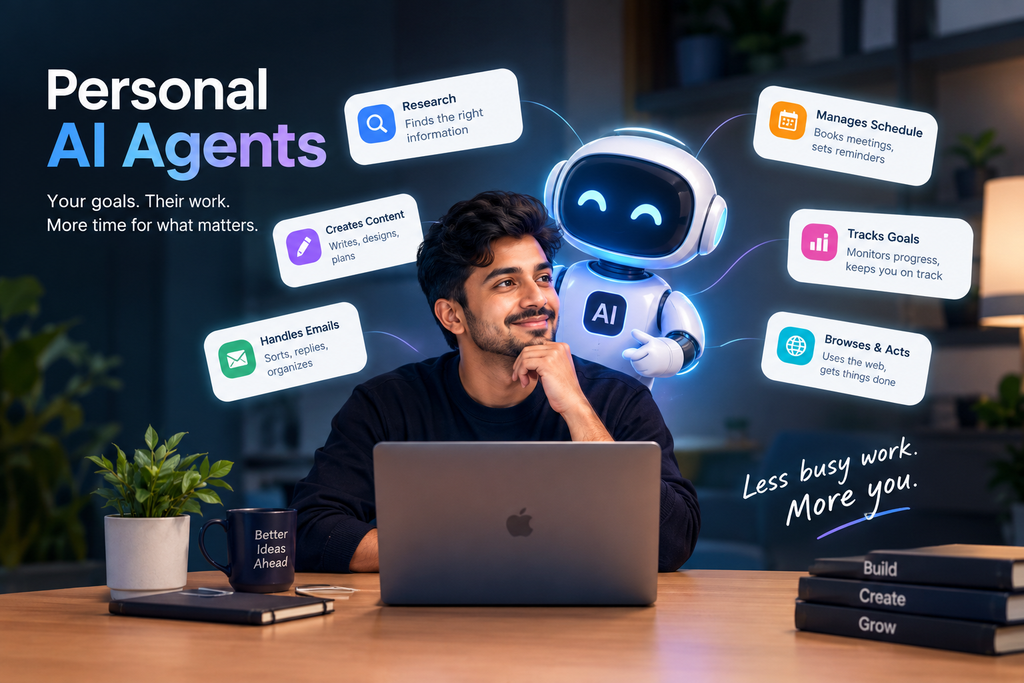
Personal AI agents are the biggest shift in everyday AI since chatbots arrived. Instead of only answering questions, they can send emails, book travel, fill out forms, and keep working after you close the app. Meta launched its own agent, Muse, in September 2026. OpenAI has offered ChatGPT agent since 2025.
That sounds great. It also raises a fair question: how much should you trust a tool that acts for you?
I work in digital marketing, so I judge personal AI agents by one test. Do they save time without hurting quality? Below, I explain what Muse and OpenAI’s agent do, how they differ, and the review habits I use before any AI-assisted work goes live.
One note on transparency: I haven’t tested Muse myself. The Muse details here come from Meta’s announcement and news coverage. My hands-on experience is with ChatGPT for marketing content, and I’ll share that too.
What Are Personal AI Agents?
A chatbot waits for your prompt and replies. A personal AI agent takes a goal, plans the steps, and uses connected tools to carry them out. It can only do what you give it permission to access.
Here is the simple difference:
| Chatbot | Personal AI agent | |
| How it works | Responds to each prompt | Plans and runs multiple steps toward a goal |
| Tools | Mostly text in, text out | Can use browsers, email, calendars, and apps |
| Your role | Do the follow-up work yourself | Approve, monitor, and correct |
| Main risk | Wrong or generic answers | Wrong answers plus wrong actions |
That last row matters most. A bad chatbot answer wastes a few minutes. A bad agent action can send the wrong email or buy the wrong thing.
What Meta Muse Does
Meta announced Muse on September 8, 2026. According to the Associated Press, it is for adults 18 and over in the United States and focuses on everyday jobs such as schedules and shopping. Meta also pitches it as a way to turn long-term goals into action plans.
Based on Meta’s announcement and press coverage, Muse can:
- Send emails and book travel
- Open a browser and fill out forms
- Shop and complete checkout, with payments handled through Stripe’s Link
- Keep working in the background after you close the app
- Remember details you share so it can make suggestions on its own
Muse runs on what Meta calls Muse Secure VM, a private virtual computer that holds both the agent and your data. Reports also describe a second agent, called Sentinel, that reviews Muse’s actions before they reach the internet. Meta says you can opt out of having your data used to train its models, and that Muse conversations are not shared with its advertising systems.
Meta itself admits that giving an AI access to personal accounts adds privacy and safety risk. Reviewers have asked the same thing: will people hand over email, calendars, and payments to an agent they can’t fully see inside?
What OpenAI’s ChatGPT Agent Does
OpenAI introduced ChatGPT agent in July 2025. It combined two earlier tools: Operator, which could use websites, and deep research, which could handle multi-step research.
When you switch on agent mode, ChatGPT can use its own virtual computer to:
- Browse websites and fill out forms
- Research a topic and build a slide deck
- Run code and create files
- Pull information from connected apps such as Gmail and GitHub
It also narrates what it is doing. You can stop it at any time or step in to clarify an instruction. OpenAI has been open about the limits. It warned at launch that the tool could make mistakes, and that agents with real-world actions face higher risks from attacks, such as malicious instructions hidden on web pages.
Meta Muse vs ChatGPT Agent
| Meta Muse | ChatGPT agent | |
| Maker | Meta | OpenAI |
| Launch | September 2026 | July 2025 |
| Pitch | A personal agent for daily life and long-term goals | An agent that bridges research and action |
| Where it runs | A private cloud computer (Muse Secure VM) | A virtual computer inside ChatGPT |
| Known safety features | Separate reviewer agent, training opt-out | Live narration, stop-anytime control |
| Best for | Errands, travel, shopping | Research, slides, multi-step work tasks |
Features and availability change fast, so check each company’s official page before you decide.
How I Use AI in Real Marketing Work
Here is a real example. I worked on a digital marketing project promoting a BMW E39. I used ChatGPT to draft social media ad copy and content ideas. It produced attention-grabbing headlines, ad descriptions, and content based on the AIDA model (Attention, Interest, Desire, Action).
It saved real time. But the first draft was not ready to publish. I had to fix three things:
- Generic headlines. I rewrote them to speak directly to E39 enthusiasts.
- Missing angle. I adjusted the ad copy to highlight the car’s classic design, which is what this audience cares about.
- Weak call to action. I changed it to encourage people to contact us for more details.
That project taught me something simple. AI gives you a fast start. You still supply the audience knowledge and the judgment.
Personal AI agents extend that idea. In marketing, they can help with competitor research, content calendars, campaign performance analysis, website traffic monitoring, and routine reporting. The more steps an agent handles, the more important your review becomes.
My Four-Step Review Checklist
Before I publish anything AI-generated, I run through this list:
- Accuracy and relevance. Are the facts right, and does this fit my target audience?
- Tone and readability. Is the grammar clean, and does it sound natural and on-brand?
- SEO elements. Are the keywords, headings, and meta description in place?
- Call to action. Does it support the marketing goal?
The goal is content that is accurate, natural, audience-focused, and ready to publish. You can use the same checklist on any output from personal AI agents.
How Much Freedom Should You Give an AI Agent?
My rule is simple. Let AI automate routine tasks, but keep humans in charge of important decisions.
| Let the agent handle | Keep for yourself |
| Scheduling posts you have already approved | Publishing sensitive or brand-critical content |
| Sending standard, low-stakes emails | Important client or partner emails |
| Pulling data into routine reports | Final decisions about budget, strategy, or purchases |
Set clear rules first. Review sensitive output. Monitor what the agent actually does. This protects your reputation and prevents costly mistakes.
Your comfort level may differ depending on your industry, your risk tolerance, and how much damage one error could cause. A regulated business should be stricter than a hobby blog.
The Biggest Mistake Beginners Make
The most common mistake is relying on AI output without checking or editing it. People publish directly, skip fact-checking, and ignore their brand voice. The result is generic content and poor engagement.
Treat AI as an assistant, not a replacement for human creativity and judgment. This matters even more with personal AI agents, because the output is an action, not just a paragraph.
One Thing to Do This Week
If you’re new, don’t start with a full agent. Start with one real marketing task, such as writing a social media post with ChatGPT.
- Write a clear prompt that names your audience and goal.
- Review the output.
- Fact-check every claim.
- Edit it to match your audience and brand voice.
This shows you both the benefits and the limits of AI. Once you trust your review process, you can give personal AI agents more responsibility step by step.
FAQs
An overview of a personal AI agent.
A personal AI agent is an AI system that performs several actions towards achieving a goal, leveraging tools like email, calendars, and browsers. It is dependent on the permissions granted to it.
What’s the difference between an AI agent and a chatbot?
A chatbot primarily repels, it answers your prompts. An agent can act – make a mistake – and it can have real consequences, like sending an email or completing a form.
Is Meta Muse safe?
Meta claims that it has integrated privacy and safety features into Muse, such as a virtual computer for privacy and a reviewer agent. Meta also admits that the dangers of providing an AI with user accounts aren’t negligible. Begin with restricted access and check out what it offers.
Can I use an AI agent to write emails or posts on my behalf?
At first just for basic, low-risk tasks. Continue to have approval for sensitive material and significant messages.
Conclusion
Personal AI agents like Meta Muse and ChatGPT agent are moving AI from talking to doing. That can save you hours, but it also raises the stakes of every mistake.
The approach that works for me is simple: automate the routine, review the important, and never publish blindly. Pick one real task this week, run my four-step checklist, and build trust slowly.
SEO and Publishing Package
SEO title: What Personal AI Agents Like Meta Muse and OpenAI Do
Meta description (151 characters): Personal AI agents like Meta Muse and OpenAI’s ChatGPT agent act, not just chat. Learn what they do, where they fall short, and how to stay in control.
URL slug: /what-personal-ai-agents-do-meta-muse-openai
Primary keyword: personal AI agents
Secondary keywords: Meta Muse, ChatGPT agent, OpenAI agent, AI agent vs chatbot, AI personal assistant, AI agents for marketing, personal AI privacy
Looking for a best trusted digital marketing expert in Kochi I help local businesses, startups, and growing brands get found online, attract the right customers, and turn clicks into real sales. With hands-on experience in SEO, Google Ads, social media marketing, content strategy, and lead generation, I build tailored campaigns that fit your goals and budget. Whether you run a restaurant in Fort Kochi, a clinic in Edappally, or an online store serving all of Kerala, my data-driven approach ensures measurable growth, higher rankings, and a stronger brand presence. If you want a digital marketing partner who understands the Kochi market and delivers results, let’s connect and grow your business together.